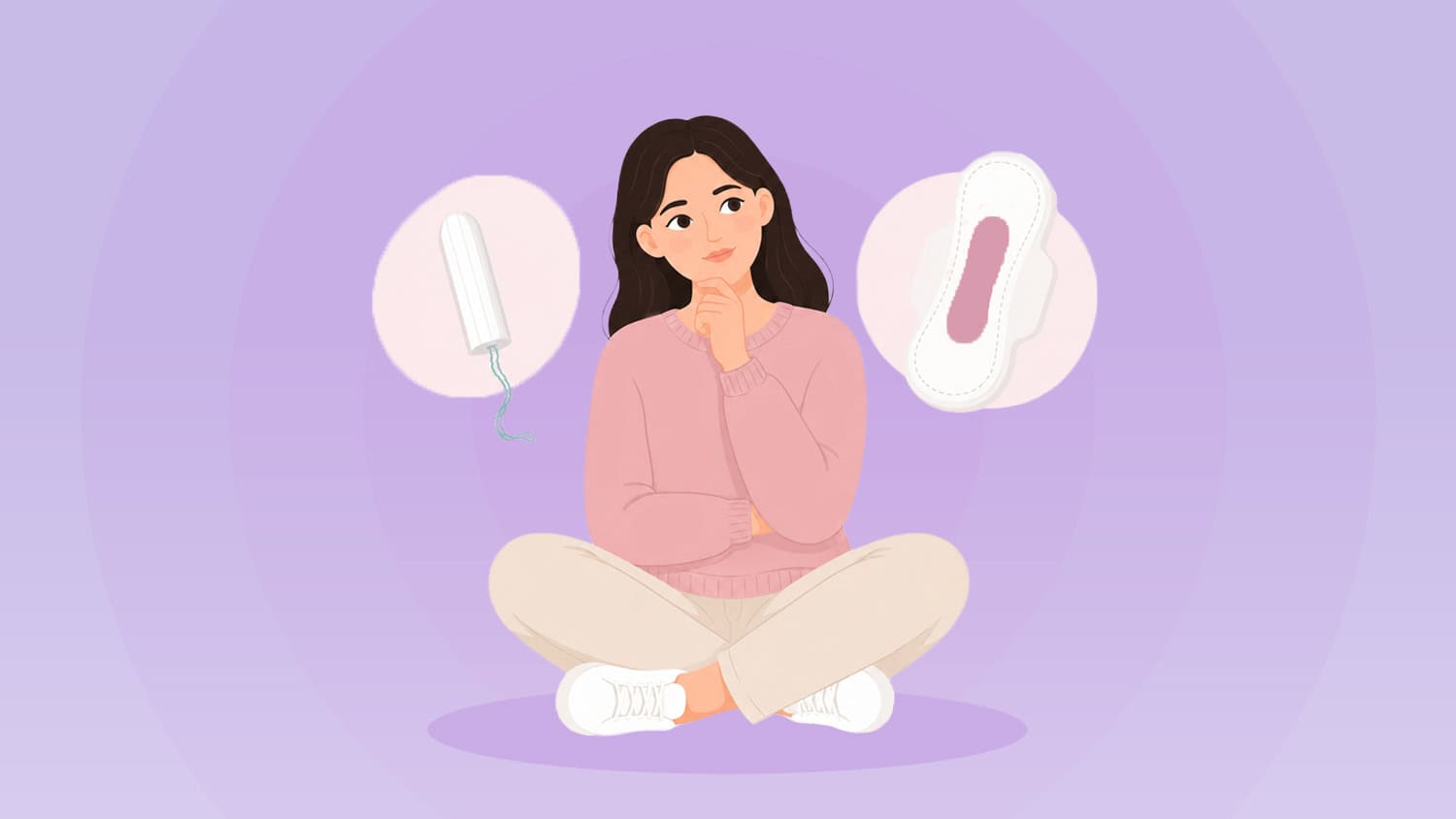
You wake up. You reach back to check the sheets. And there it is: a stain you’ll spend the morning scrubbing out. Sound familiar? Almost everyone who’s had a period has a story like this, probably more than one. Maybe it happened during a sleepover, the first week you tried a new product, or just on a night when your flow was heavier than usual. It doesn’t have to keep happening, though. A few simple changes — how you sleep, which product you use, and how you protect your bed — can stop that morning before it starts. And if leaks are showing up more nights than not, that’s useful information too, not just something to quietly live with. Here’s what actually works, why nighttime leaks happen in the first place, and when a leaky night means it’s time to call your doctor.
On this page
- What’s really happening in your body at night?
- It’s okay to feel embarrassed
- What’s the best sleeping position to avoid leaks?
- Which period product protects you best overnight?
- How can you layer up on heavy nights?
- How do you protect your mattress and sheets?
- What should you do if you wake up to a stain?
- When to see a doctor?
Key takeaways
- Your period isn’t really heavier at night. It just feels that way, because blood pools while you’re lying down.
- Sleeping on your side with your knees tucked in (called the fetal position) can help stop leaks and ease cramps.
- Overnight pads, period underwear, and menstrual cups or discs last longer than daytime products. Tampons are different: the FDA says never wear one for more than eight hours.
- A waterproof mattress cover and dark sheets protect your bed, even on nights when a leak still happens.
- Changing your pad or tampon in the middle of the night is one sign of heavy bleeding. Tell your doctor if it keeps happening.
What’s really happening in your body at night?
Your period doesn’t actually get heavier at night. It just feels that way.
During the day, you’re up and moving, so blood flows out steadily and never builds up in one spot. Lying down changes that. Blood can pool for a while, then come out all at once when you shift positions or get up. That’s why your first bathroom trip in the morning can feel like the heaviest moment of your whole period.
Hormones play a part too; right before and during your period, a hormone called progesterone drops fast. This hormone normally has a calming effect on your brain and helps you sleep. Studies on sleep and the menstrual cycle show this drop can make your sleep lighter.1 You toss, turn, and wake up more than at other times of the month. The more you move, the more chances a pad has to shift or a tampon has to slip off center. That’s often when a leak starts.
It’s okay to feel embarrassed
Feeling embarrassed about a stain is a common reaction, but it doesn’t mean anything went wrong. Periods are a normal part of having a body. Leaks happen to almost everyone at some point, even with the right product and the right sleep position. If you’re staying somewhere other than home, a quick, casual heads up takes the pressure off. Something like mentioning you need to toss in a load of laundry is enough, no big explanation needed. At home, treat it like any other spill: clean it up, then get on with your morning. A stain on your sheets says nothing about how well you’re managing your period.
What’s the best sleeping position to avoid leaks?
How you sleep matters almost as much as what you use.
- Fetal position: Lie on your side with your knees pulled up toward your chest. This is often the comfiest option, and one of the best for stopping leaks. It takes pressure off your belly, which may help ease cramps, based on interviews with nursing students in a small international study.2
- On your back, with a pillow under your knees: This spreads blood more evenly instead of letting it pool in one spot. The pillow also takes pressure off your lower back.
- Try to avoid your stomach: Lying face down presses on a cramping uterus, which most people find uncomfortable. It also makes it harder for a pad to stay lined up the way it should.
Which period product protects you best overnight?
Your daytime pad or tampon may not hold up through eight hours of lying down. Here’s how the main overnight options compare.
| Product | How long it can stay in | Best for |
| Overnight pad | Put on a fresh one right before bed; go up a size if you soak through before morning | Most people, easiest to use |
| Tampon | Never more than 8 hours, per FDA guidance3 | Shorter nights, or light to medium flow |
| Menstrual cup or disc | Up to 12 hours, per FDA guidance4 | Heavy flow, full night of coverage |
| Period underwear | Worn alone overnight, or as backup with a pad | Lighter nights, or extra security |
Tampons work well during the day, but at night they come with a real limit. The FDA recommends changing a tampon every four to eight hours, and never leaving one in for more than eight hours. Wearing one too long raises your risk of toxic shock syndrome (TSS), a rare but serious illness that happens when bacteria multiply in a tampon left in too long and release toxins into your bloodstream.3 If you tend to sleep longer than eight hours, a tampon alone isn’t your safest choice. A pad, period underwear, or a menstrual cup or disc are better picks for a full night’s sleep.
Cups and discs work a bit differently. Instead of soaking up blood, they collect it, and the FDA says they can safely stay in for up to 12 hours. That makes them one of the few products actually built to last through a whole night without a change.4 They take some practice to put in and take out. Try one on a lighter day first, before you need it to work perfectly overnight.
How can you layer up on heavy nights?
On heavier nights, doubling up gives you extra peace of mind.
- Pad plus period underwear: Wearing absorbent underwear over a pad adds a backup layer. This helps most if you tend to leak out the back.
- Cup or disc plus a thin liner: The liner catches any small drops that escape before your cup is fully in place, or right after you empty it in the morning.
- Tampon plus a pad: This combo works, but the tampon’s eight-hour limit still counts. Set an alarm if you’re relying on a tampon overnight, or switch to just a cup, disc, or pad for longer stretches of sleep.
How do you protect your mattress and sheets?
Even the right product can’t promise zero leaks, so it helps protect your bed too.
- A waterproof mattress cover: This stops a leak from soaking into the mattress itself, which is much harder to clean than a set of sheets.
- Dark colored sheets: Dark fabric hides small stains and tends to be easier to clean than light colors.
- An old towel folded under your hips: This catches a leak early, before it reaches your mattress cover or sheets.
What should you do if you wake up to a stain?
Rinse the fabric in cold water as soon as you can. Hot water can set a blood stain instead of lifting it out, which makes it much harder to remove later. After rinsing, work in a little mild soap or a stain remover with enzymes in it, and that usually finishes the job. If any color is left, let the fabric air dry instead of using the dryer. Heat can lock in a stain that cold water and soap didn’t fully clear.
When to see a doctor?
A leak now and then is just part of having a period. But some patterns mean it’s time to see a doctor. The American College of Obstetricians and Gynecologists (ACOG) lists these as signs of heavy menstrual bleeding5:
- Changing your pad or tampon during the night
- Soaking through a pad or tampon every hour, for several hours in a row
- Bleeding for more than seven days
- Needing more than one pad at a time
- Passing clots as big as a quarter or larger
Heavy bleeding like this can lead to low iron over time, called anemia. It can leave you feeling tired, short of breath, or dizzy.56
Call for emergency care right away if you have:
- Soaking through a pad or tampon every hour for more than two hours in a row
- Chest pain
- Shortness of breath
- Lightheadedness or dizziness7
Frequently asked questions
No, it’s not a good idea. Even light flow can leak while you sleep and move around. If you’d rather skip pads or tampons, period underwear is a comfortable option on lighter flow days.
Yes, as long as you take it out within eight hours. If you usually sleep longer than that, switch to a pad, period underwear, or a menstrual cup or disc for the night instead.
Up to 12 hours. Put it in before bed and empty it first thing in the morning.
Blood pools while you lie flat, then comes out when you stand up or shift positions. That’s why your first bathroom trip of the day often feels heavier than it really is.
You can, especially on heavy days. Try overlapping two pads, or pairing a pad with period underwear, for extra coverage toward the back, where leaks happen most.
Rinse with cold water as soon as you can, since hot water can set the stain. Follow with mild soap or an enzyme-based stain remover, then let it air dry until the stain is gone.
If you’re often waking up to change your pad or tampon, soaking through a pad every hour for several hours, or passing large clots, it’s time to talk with your OB-GYN.
Lie on your side with your knees tucked toward your chest. This is called the fetal position, and it tends to work best. It keeps your legs close together and can ease cramps at the same time.
Last medically reviewed on
References
Our commitment to accuracy is paramount; we use high-quality sources, including peer-reviewed studies, to support the facts in our articles. Learn more about our Editorial Process.
- Nowakowski, S., Meers, J., & Heimbach, E. (2013). Sleep and women's health. Sleep Medicine Research, 4(1), 1-22. pmc.ncbi.nlm.nih.gov
- Fernández-Martínez, E., Pérez-Corrales, J., Palacios-Ceña, D., Abreu-Sánchez, A., Iglesias-López, M. T., Carrasco-Garrido, P., & Velarde-García, J. F. (2022). Pain management and coping strategies for primary dysmenorrhea: A qualitative study among female nursing students. Nursing Open, 9(1), 637-645. pmc.ncbi.nlm.nih.gov
- U.S. Food and Drug Administration. (2026, July 6). Tampons. fda.gov
- U.S. Food and Drug Administration. (2026, July 6). Menstrual cups. fda.gov
- American College of Obstetricians and Gynecologists. (2022, June). Heavy menstrual bleeding. acog.org
- Office on Women's Health. (2026, January). Iron-deficiency anemia. womenshealth.gov
- American College of Obstetricians and Gynecologists. Abnormal uterine bleeding. acog.org
Update history
Our team monitors the health and wellness space to keep articles current.
Current version (August 17, 2026) — Written by Dr. Ramisha Farooq, MBBS. Medically reviewed by Dr. Sadaf Iftikhar, MBBS, FCPS.
April 7, 2025 — Medically reviewed by Dr. Sadaf Iftikhar, MBBS, FCPS. Written by Dr. Musfirah Maryum, MBBS.